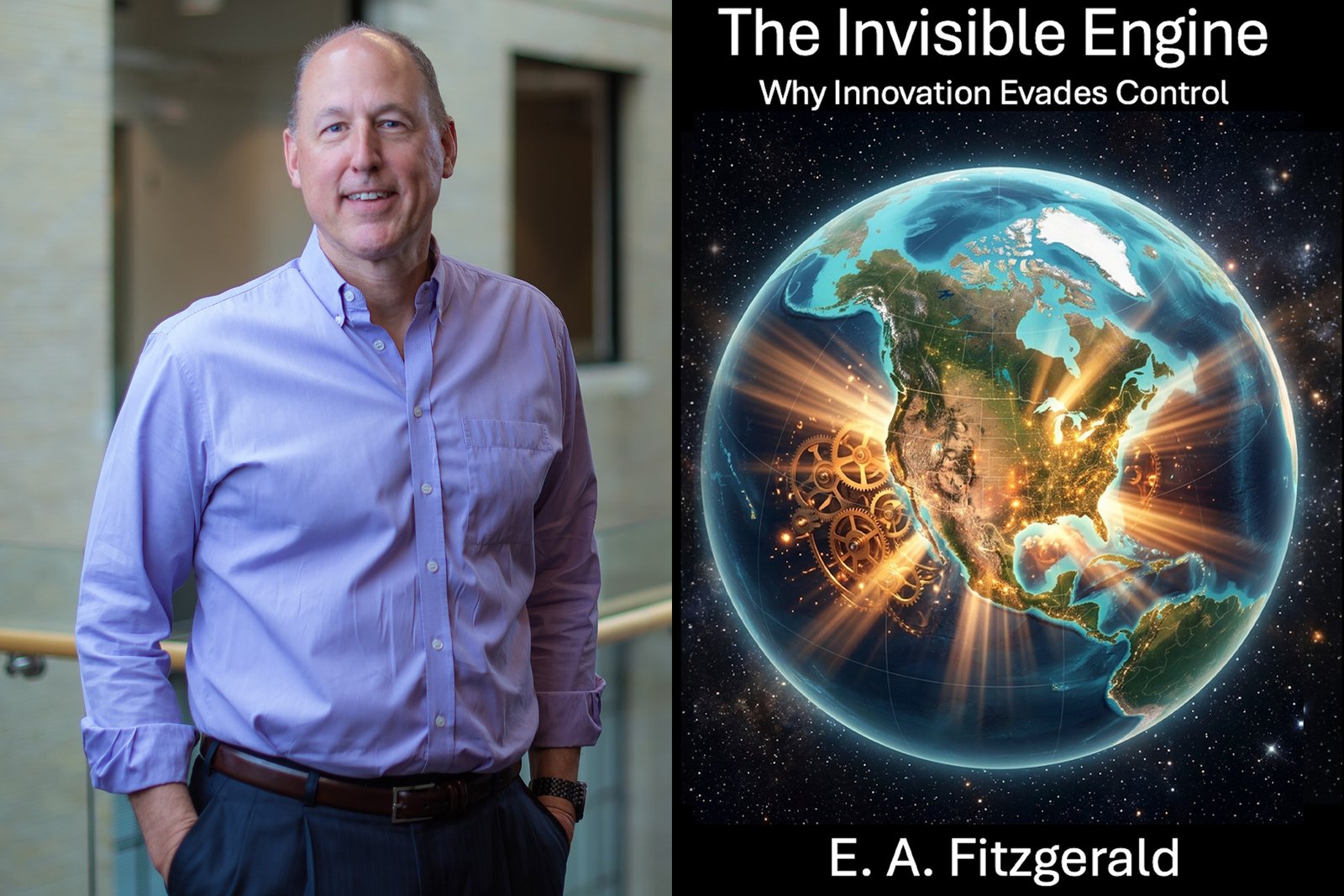

Innovation is a concept that has become mythologized in the modern era: what it is, how to manage it, how to teach it, and how to get it to work for us. Despite these explorations, it remains fundamentally misunderstood, writes Eugene Fitzgerald, the Merton C. Flemings SMA Professor in MIT’s Department of Materials Science and Engineering, in his latest book, “The Invisible Engine: Why Innovation Evades Control.”
Fitzgerald draws on a decade of work leading international research programs, including the MIT and Masdar Institute Cooperative Program and the MIT-Singapore Alliance for Research and Technology, where he explored innovation as the integration of market applications, technology, and implementation.
Written at a moment when artificial intelligence is reshaping how we think about knowledge, research, and innovation, “The Invisible Engine” examines a deeper question: How does innovation actually happen, and how should society invest in it?
In this interview, Fitzgerald discusses his own experiences with innovation — including his co-invention of strained silicon at AT&T Bell Laboratories in the 1990s, which helped extend Moore’s Law, the semiconductor industry’s long-standing trend of increasing the number of transistors on chips roughly every two years — while exploring common misconceptions about innovation, how to create the conditions for it, and novel ways to prepare institutions for future uncertainty.

Q: What inspired you to write this book?
A: The book really grew out of the last 10 years of work in research-to-market activity, from the MIT Masdar program to the MIT-Singapore Alliance. In science, we have professional journals and things like that that capture discoveries within individual fields, but these larger-scale projects — where science, economics, industry, and society all intersect — don’t really have an academic thread that connects them.
I wanted to write a book that condensed all of those connections, because the innovation process at that scale is really the intersection of many different fields. The dominant ones are science and economics, because those are the underlying principles that drive how innovation happens.
So I was interested in marking this moment in history and documenting the experiments we’ve done at scale — trying to understand how knowledge of the innovation process can be incorporated into large collaborative research programs.
What started as a practical effort to make these programs work became a broader and somewhat unexpected interest in the innovation process itself.
Q: What is the “invisible engine?”
A: The invisible engine is this decentralized collective intelligence of different actors, which are people and companies that eventually create surprise in the marketplace, which brings great profit.
This concept of “surprise” comes from Frank Knight, an economist from the early 1900s who was trying to understand the Industrial Revolution happening around him. So he takes a close look at the entrepreneur and asks, “What does the entrepreneur do?” And his answer is that the entrepreneur takes on uncertainty. They bring something into the world without knowing exactly what will happen, and their reward is surprise — everyone is surprised that people want it and that it can be done. Because the entrepreneur is the first to discover that opportunity, they can earn a profit.
Q: How did your experience developing semiconductor technologies shape the ideas in the book?
A: It started with Bell Labs. My colleague and I made an important discovery — we found a way of straining silicon in a thin-film form with very few defects, which had never been done before. From the physics point of view, it was a big result. But I was always interested in having impact in the world, not just scientific recognition, so I went to my manager and asked, “What do we do next?”
He said, “Go talk to the marketing people at AT&T.” In hindsight, that made perfect sense. Bell Labs, like a lot of great industrial labs, created a lot of stuff, but they couldn’t always commercialize it.
Then I came to MIT, which was an open aperture after Bell Labs. Here I could keep uncertainty open across all the elements and find convergence in different directions. Eventually I started a company, and going between institutions to stimulate things was an eye-opening experience. We eventually reached a settlement with Intel over a patent dispute because the industry discovered that strained silicon was needed to extend Moore’s Law — something we never expected.
A lot of people want things to be organized and say, “Oh yeah, look at all that chaos.” But no — the path from Bell Labs to MIT to a startup, and then to industry adoption, was the innovation process.
Q: What’s the biggest misconception about innovation?
A: People think that all research investment works the same way if the goal is economic impact. But there are actually three different kinds of research investment, and they’re meant for different things.
There’s the one we all know about, which I call “altruistic science.” The purpose of altruistic science — in investing in an academic institution — is to produce educated people. It’s not done in the context of the world that ideas eventually have to succeed in. And if you honestly look at the direct economic yield over all these years, it’s basically zero.
Strategic research is the second investment category. As opposed to a single area of technology or science, it’s organized around a goal. A new F-35, for example, may need advancements in several fields, so the customer — in this case the government — wants them to come together. Basically, they’re taking economics out of the equation because they’re the only customer, but they have much broader uncertainty because they have multiple domains of technology that they have to deal with.
The third category is what I call “fundamental innovation.” It’s meant to represent the whole process from research to economic growth, even if it’s on 10-, 15-, or 20-year time horizons. Fundamental innovation is different because it has three variables: technology — what is physically possible; implementation — how it can be built and delivered; and market — who will adopt it, and why. Fundamental innovation involves all the necessary elements the whole time to converge on possible value. So you’re thinking about market applications the whole time, you’re thinking about new science and technology that could create new innovation options. Then you’re working in the real world saying, “OK, here’s how implementation would happen today, but maybe this could change, maybe that could change.” Not only are you doing your research, but the world is changing at the same time.
So that’s really the biggest misconception — that innovation is about an idea. It isn’t. It’s a process of working with things in the world until they become valuable.
Q: Who did you write the book for?
A: I wrote it for multiple audiences: individual innovators and students; researchers and faculty; corporate leaders; research funders; and policy-makers. So, people who have a stake in trying to figure out, either with their careers or with their investments — whether it’s government or private — how to invest in the far future.
Q: What’s one lesson you hope readers take away?
A: For the policy people, I would say: Understand how innovation works in the economy, stop getting in its way, come up with new methods to drive it more efficiently, and realize there are three different streams of investment — altruistic, strategic, and this fundamental innovation stream that is not purposely being funded.
For students, I think understanding this is how you can actually have impact. What I point out in the book is that being involved in the innovation process makes you T-shaped: You have technical depth in one area and a broad working knowledge of many areas. If you’re doing research under these conditions, you start to learn about the world and all these different dimensions. It inherently includes business, economics, and applications. You’ve become broader, but then you still have the technical depth to drill down into any area.
For universities, this is who we should be. We should be teaching people how to do this and how to participate in these research corporations that I’m talking about. I call them third places: places that bring everybody together for this purpose — for investment, for everything else. Universities are the ones that can really trigger that, because companies aren’t going to have enough time. The government and universities should be targeting these third places for innovation, and students and faculty will be able to become more T-shaped through that interaction.