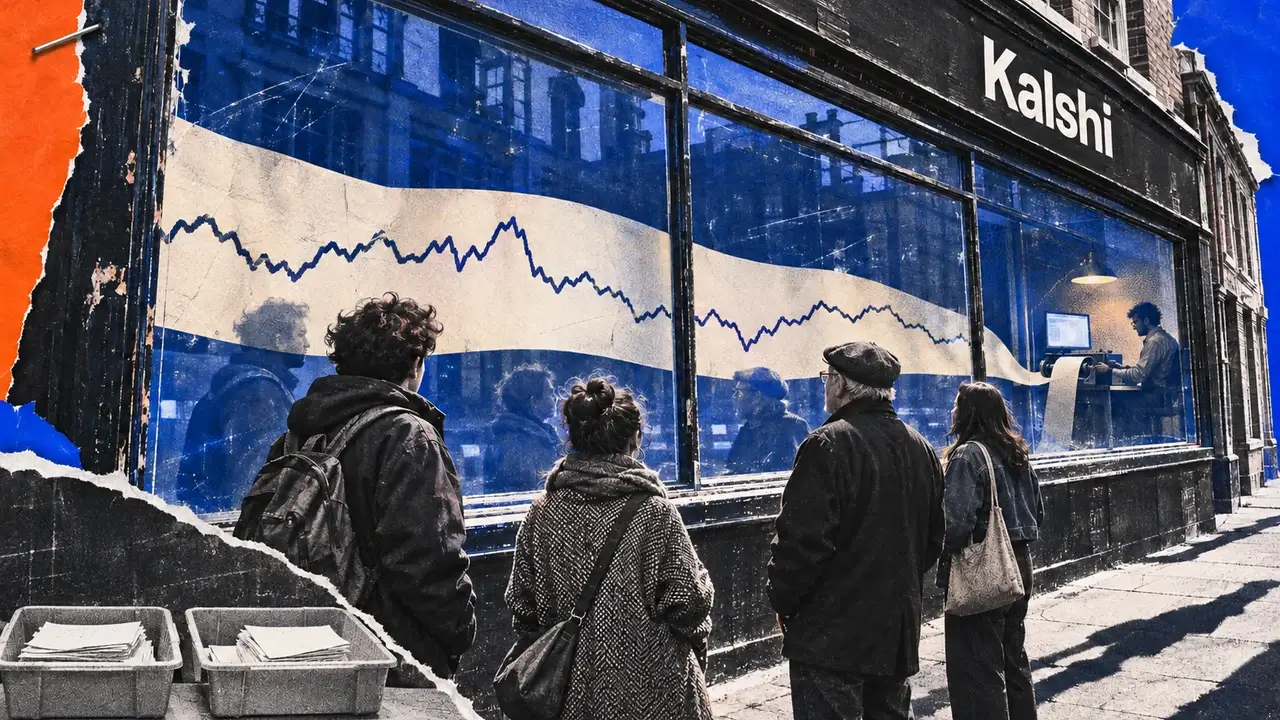

Kalshi says people watching its midterm markets outnumbered traders five to one. For those spectators, Kalshi offers a forecast that keeps moving while the country waits for an answer.
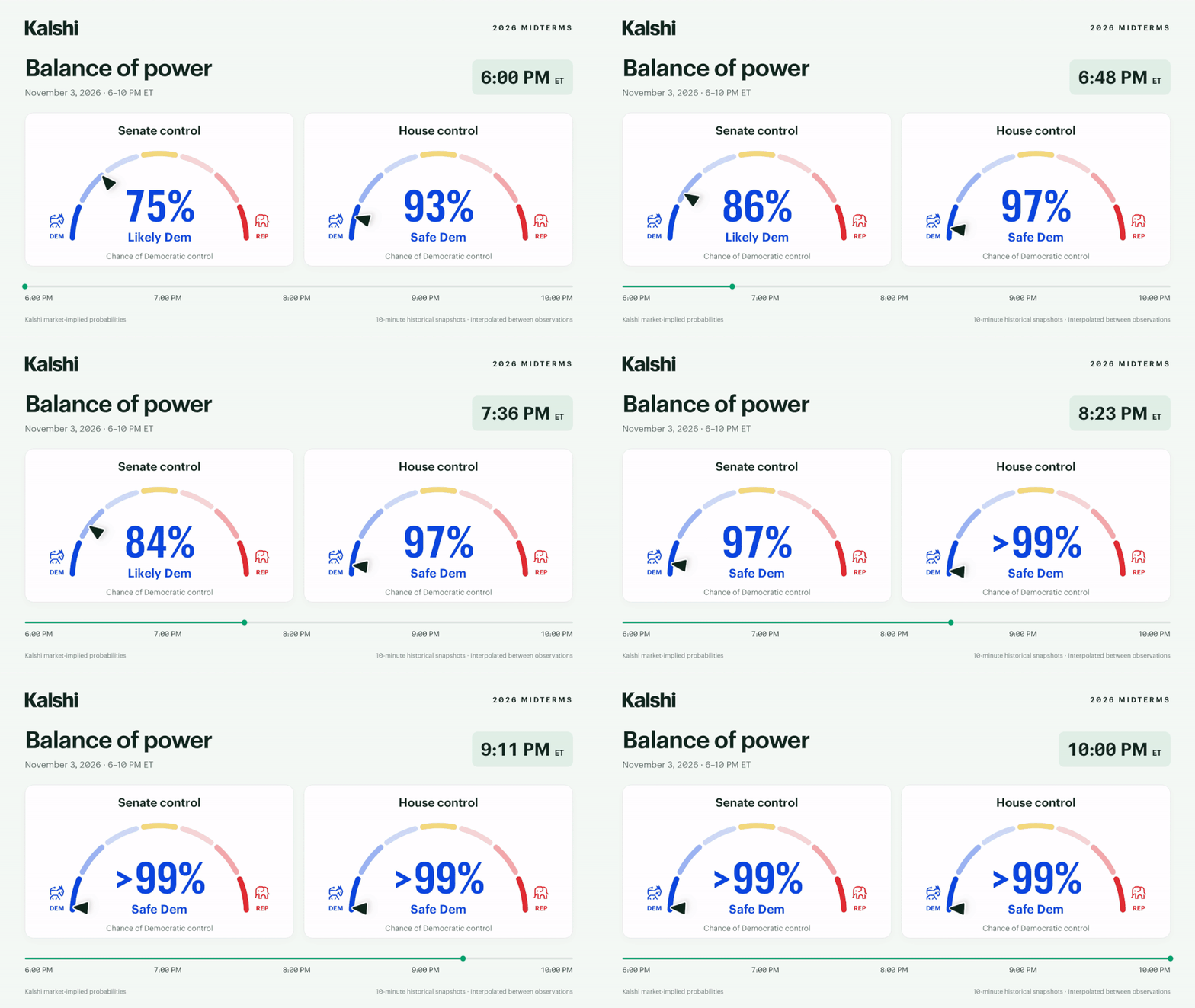
You could spend election night on Kalshi without buying anything, as millions of people did this week. Its midterm display offered maps of congressional races and gauges tracking control of the House and Senate, with percentages changing in real time as the evening unfolded.
It’s easy to understand why traders keep such a close eye on Kalshi: every little change in odds changes the value of their positions. Given how much money actually moved hands during the midterms, it’s no wonder hundreds of thousands of traders were glued to the platforms.
But millions of people were also looking at Kalshi who weren’t making any bets, with most not even having accounts on the platform. In October, Kalshi said viewers of its midterm markets outnumbered traders five to one.
Kalshi’s post-election recap reported more than $2.5 billion in midterm trading volume, compared with $1.3 billion for the 2024 election cycle.

Kalshi’s reported election-market volume
Kalshi’s Nov. 4, 2026 recap reports $1.3 billion for the 2024 election cycle and more than $2.5 billion for 2026 midterm markets. The 2026 bar marks the reported lower-bound threshold, not an exact total. Kalshi uses notional volume to measure trading activity; these figures do not count viewers or unique traders. The recap does not specify matching market coverage or start and end times for the two periods.
 CryptoSlate
While Kalshi’s numbers are hard to verify and the company hasn’t provided an exact measurement period or a definition of its ratio, they show a second use for the exchange: following politics without placing a bet, while letting the people who do bet help shape your expectations.
We were watching before the apps
On Aug. 20, 2008, Wolf Blitzer turned to CNN’s internet reporter, Abbi Tatton, for an update on speculation about Barack Obama’s running mate. Tatton brought him a number from Intrade, an online prediction market: Joe Biden was trading at about 36%.
Biden led the other candidates she named and would ultimately get the job, although 36% still left substantially more room for someone else to be chosen.
Tatton also mentioned CNN’s own political market, which used virtual dollars. Viewers could follow the odds or play along without risking real money. Everybody wanted to put a number on political suspense, and it was a perfect fit for a television segment about the elections.
Kalshi’s election hub combines market odds with polling averages, fundraising figures, and campaign news, giving visitors several ways to follow a race in one place.
A contract paying $1 if a candidate wins, and nothing if they lose, might trade at 65 cents. That price is commonly read as roughly a 65% chance of victory, although fees, available trading volume, and the contract’s rules slightly erode those numbers.
Polls gather answers from a sample of people, forecasts estimate an outcome based on historical evidence and assumptions, and a market then sets a price at which participants will trade. These can inform one another, but a percentage alone doesn’t reveal how it was produced or what it measures.
The trader has to decide whether 65 cents is worth paying, and the spectator can simply take away the expectation that the candidate will probably win. That means that someone else’s financial judgment has become part of their understanding of the election.
Something to watch between polls
The market still has something to show you between a poll’s release and the next substantial development. It can adjust after a debate, absorb new returns, or reflect a change in how traders interpret already available evidence.
Those movements look much the same on a screen: a percentage rises or falls, inviting the viewer to read the change as news.
Kalshi acknowledges in its explanation of why prices move that fresh information is only one cause. Trader behavior can also push prices away from a reasonable estimate, and watching the percentage doesn’t necessarily reveal what has happened.
A candidate can appear to be gaining ground because the chance attached to their name has increased, even when no additional voter has been interviewed and no additional ballot counted.
An experiment involving 1,994 registered voters showed how easily those percentages can shape expectations.
Participants saw pairs of hypothetical congressional candidates, with randomly varied polling figures and market odds. Higher displayed odds made respondents more likely to identify a candidate as the expected winner.
Traders can bring knowledge that a casual observer lacks, and money gives someone who spots a mistaken price a reason to act. The commercial effort to attract an audience doesn’t remove the possibility that the resulting forecast is good.
But a poll and a market reacting to that poll can look like two separate endorsements of a candidate’s prospects when they draw on the same evidence. Those just observing the market get more perspectives without necessarily getting more independent information.
The race to 99%
In its post-election recap, Kalshi said its markets reached 99% for Democratic House control at 8:10 p.m. Eastern and passed that level for Senate control at 9 p.m.
The company said its prices reflected anticipated results ahead of television networks and offered replays showing how the graphics changed through the evening.
But an exchange and a newsroom have to answer different questions, since a market can express overwhelming confidence while leaving room for a loss.
The Associated Press says it calls a race only when the trailing candidates no longer have a path to victory. For congressional control, it counts the seats actually needed for a majority.
Neither a price nor a news organization’s call is the official certification of an election. But the call takes responsibility for saying the outcome has been established, a different claim from assigning it a probability.
A market that gets to 99% first doesn’t show that journalists took longer to perform the same task.
AP supplies Kalshi with vote counts and race calls, which the exchange places alongside its forecasts and traders can use to reconsider their positions. The market depends in part on the reporting against which it is judged.
Kalshi’s recap points readers toward international elections and the 2028 presidential contest, inviting them to follow the odds beyond one election night.
Spectators will most likely want an early estimate from a prediction market but still wait for a newsroom to declare a winner.
The price of these contracts shows how strongly traders expect an outcome, and the race call says the remaining votes can no longer change it. People who never risk a dollar still have to decide how much authority to give the price, especially when its movement is the only thing that has changed.