
The MIT Siegel Family Quest for Intelligence (SQI), a research unit in the MIT Schwarzman College of Computing, brings together researchers from across MIT who combine their diverse expertise to understand intelligence through tightly coupled scientific inquiry and rigorous engineering. These researchers engage in collaborative efforts spanning science, engineering, the humanities, and more.
SQI seeks to comprehend how brains produce intelligence and how it can be replicated in artificial systems to address real-world problems that exceed the capabilities of current artificial intelligence technologies.
“In SQI, we are studying intelligence scientifically and generically, in the hope that by studying neuroscience and behavior in humans and animals, and also studying what we can build as intelligent engineering artifacts, we’ll be able to understand the fundamental underlying principles of intelligence,” says Leslie Pack Kaelbling, SQI director of research and the Panasonic Professor in the MIT Department of Electrical Engineering and Computer Science.
“We in SQI believe that understanding human intelligence is one of the greatest open questions in science — right up there with the origin of the universe and our place in it, and the origin of life. The question of human intelligence has two parts: how it works, and where it comes from. If we understand those, we will see payoffs well beyond our current imaginings,” says Jim DiCarlo, SQI director and the Peter de Florez Professor of Neuroscience in the MIT Department of Brain and Cognitive Sciences.

Exploring the great mysteries of the mind
The MIT Siegel Family Quest for Intelligence was recently renamed in recognition of a major gift from the Siegel Family Endowment that is enabling further growth in SQI’s research and activities.
SQI’s efforts are organized around missions — long-term, collaborative projects rooted in foundational questions about intelligence and supported by platforms — systems, and software that enable new research and create benchmarking and testing interfaces.
“Ours is the only unit at MIT dedicated to building a scientific understanding of intelligence while working with researchers across the entire Institute,” DiCarlo says. “There has been remarkable progress in AI over the past decade, but I believe the next decade will bring even greater advances in our understanding of human intelligence — advances that will reshape what we call AI. By supporting us, David Siegel, the Siegel Family Endowment, and our other donors are demonstrating their confidence in our approach.”
A legacy of interdisciplinary support
In 2011, David Siegel SM ’86, PhD ’91 founded the Siegel Family Endowment (SFE) to support organizations working at the intersections of learning, workforce, and infrastructure. SFE funds organizations addressing society’s most critical challenges while supporting innovative civic and community leaders, social entrepreneurs, researchers, and others driving this work forward. Siegel is a computer scientist, entrepreneur, and philanthropist. While in graduate school at MIT’s Artificial Intelligence Lab, he worked on robotics in the group of Tomás Lozano-Pérez — currently the School of Engineering Professor of Teaching Excellence — focusing on sensing and grasping. Later, he co-founded Two Sigma with the belief that innovative technology, AI, and data science could help uncover value in the world’s data. Today, Two Sigma drives transformation across the financial services industry in investment management, venture capital, private equity, and real estate.
Siegel explains, “The human brain may very well be the most complex physical system in the universe, yet most people haven’t shown much interest in how it works. People take the mind for granted, yet wonder so much about other scientific mysteries, such as the origin of the universe. My fascination with the brain and its intersection with artificial intelligence stems from this. I don’t care whether there are commercial applications for this quest; instead, we should pursue research like that done at the MIT Siegel Family Quest for Intelligence to advance our understanding of ourselves. As we uncover more about human intelligence, I am hopeful that we will lay the groundwork not only for advancing artificial intelligence but also for extending our own thinking.”
As a long-time champion of the Center for Brains, Minds, and Machines (CBMM), a National Science Foundation-funded collaborative interdisciplinary research thrust, and one of the first donors to the MIT Quest for Intelligence, David Siegel helped lay the foundation for the research underway today. In early 2024, he founded Open Athena, a nonprofit that bridges the gap between academic research and the cutting edge of AI. Open Athena equips universities with elite AI and data engineering talent to accelerate breakthrough discoveries at scale. Siegel serves on the MIT Corporation Executive Committee, is vice-chair of the Scratch Foundation, and is a member of the Cornell Tech Council. He also sits on the boards of Re:Build Manufacturing, Khan Academy, NYC FIRST, and Carnegie Hall.
A Catalyst for Global Collaboration
MIT President Sally Kornbluth says, “Of all the donors and supporters whose generosity fueled the Quest for Intelligence, no one has been more important from the beginning than David Siegel. Without his longstanding commitment to CBMM and his support for the Quest, this community might never have formed. There’s every reason to think that David’s recent gift, which renames the Quest for Intelligence and also supports the Schwarzman College of Computing, will be even more powerful in shaping the future of this initiative and of the field itself.” She continues, “Fueled by generous donors — particularly David Siegel’s transformative gift — SQI is poised to take on an even more important role.”
SQI scientists and engineers are presenting their work broadly, publishing papers, and developing new tools and technologies that are used in research institutions worldwide, as they engage with colleagues in disciplines across the Institute and in universities and institutions around the globe. DiCarlo explains, “We’re part of the Schwarzman College of Computing, at the nexus between the people interested in biology and various forms of intelligence and the people interested in AI. We’re working with partners at other universities, in nonprofits, and in industry — we can’t do it alone.”
“Fundamentally, we’re not an AI effort. We’re a human intelligence effort using the tools of engineering,” DiCarlo says. “That gives us, among other things, very useful insights for human learning and health, but also very useful tools for AI — including AI that will just work a lot better in a human world.”
The entire SQI community of faculty, students, and staff is excited to face new challenges in the efforts to understand the fundamentals of intelligence.
New missions and next horizons
SQI research is broadening: Mission principal investigators are integrating their efforts across areas of interest, increasing their impact on the field. In the coming months, the organization plans to launch a new Social Intelligence Mission.
“We need to focus on problems that mirror natural and artificial intelligence — making sure that we are evaluating new models on tasks that mirror what humans and other natural intelligence can do,” says Nick Roy, SQI director of systems engineering and professor of aeronautics and astronautics at MIT. He predicts that SQI’s future research will rely on asking the right questions: “[While] we are good at picking tasks that test our computational models, and we’re extremely good at picking tasks that kind of align with what our models can already do, we need to get better at choosing tasks and benchmarks that also elicit something about natural intelligence,” he says.
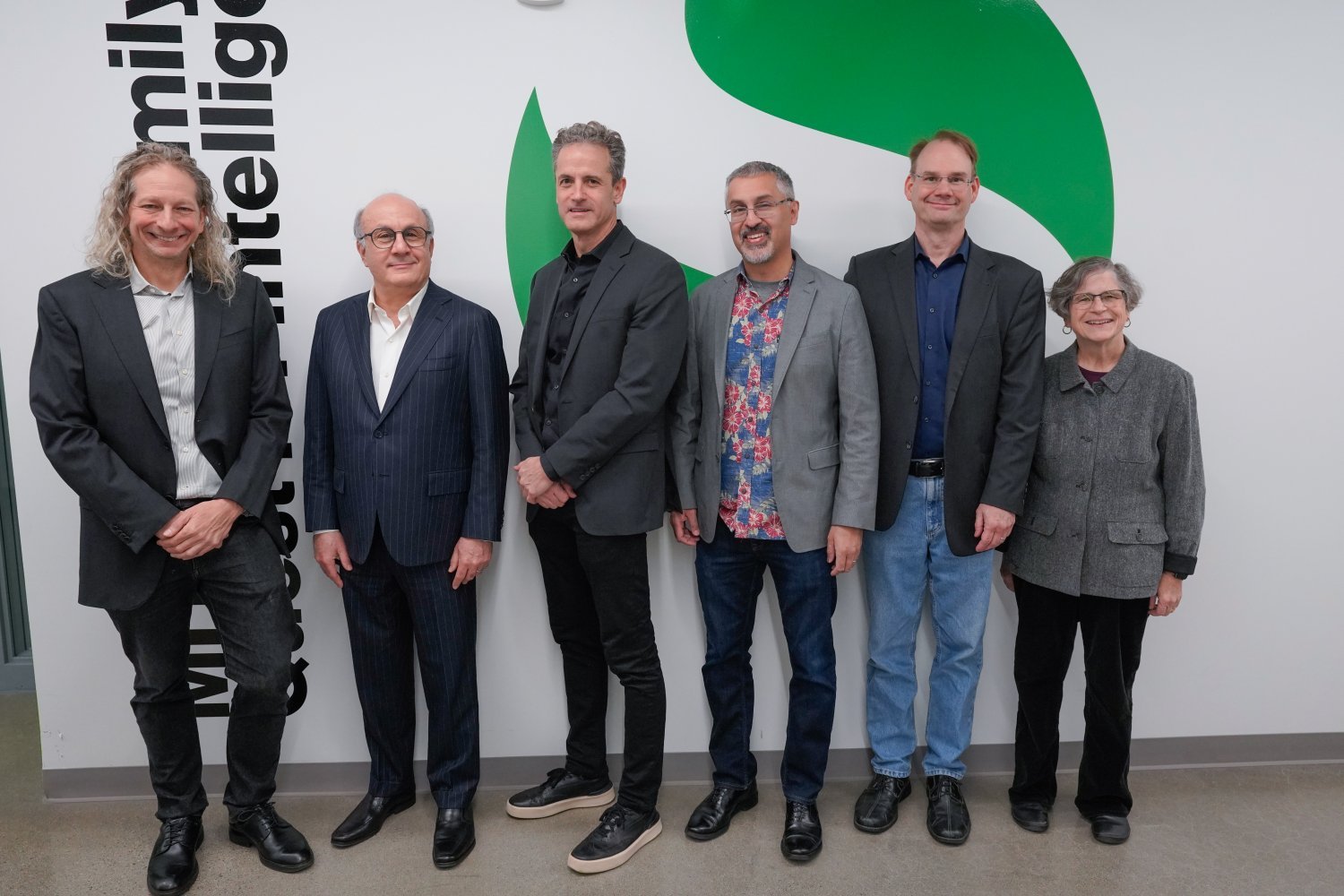
On November 24, 2025, faculty, staff, students, and supporters gathered at an event titled “The Next Horizon: Quest’s Future” to celebrate SQI’s next chapter. The event consisted of an afternoon of research updates, a panel discussion, and a poster session on new and evolving research, and was attended by David Siegel, representatives from the Siegel Family Endowment, and various members of the MIT Corporation. Recordings of the presentations from the event are available on SQI’s YouTube channel.