
In brief
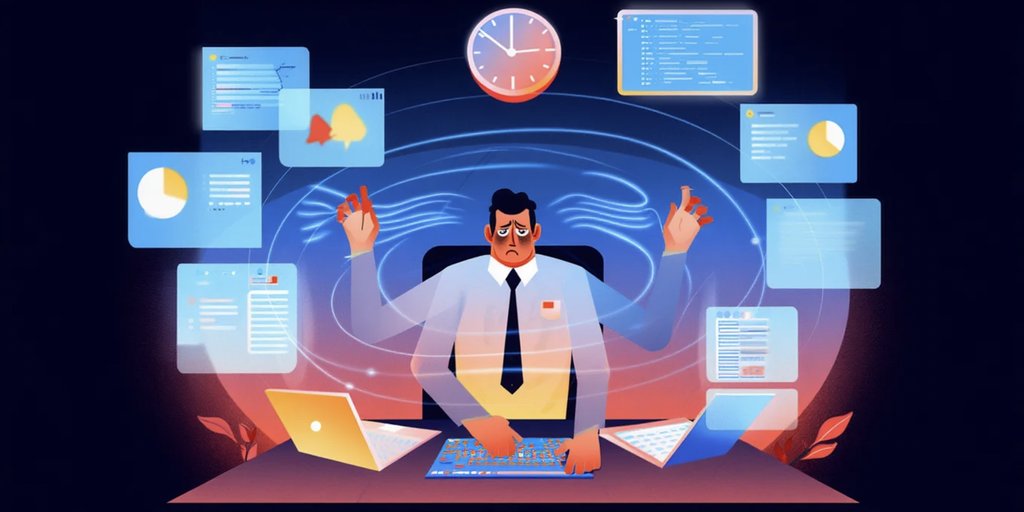
- Research published on the Harvard Business Review found that AI is accelerating work, not reducing it.
- Productivity gains are morphing into burnout and workload creep.
- The real shift isn’t job loss—it’s work intensification and reorganization.
A new study published in Harvard Business Review this week confirmed what many workers already suspected: AI tools don’t reduce work, they intensify it.
The study cited data from UC-Berkeley and Yale, collected during eight months of embedded research at a 200-person tech company, where employees voluntarily adopted AI tools.
The results showed distinct patterns of work intensification that quietly snowballed into what researchers call “workload creep.”
First came task expansion. Product managers began writing code. Researchers took on engineering work. Roles that once came with clear boundaries blurred as workers handled jobs that previously sat outside their remit. AI made that shift feel feasible.
“You had thought that maybe, ‘oh, because you could be more productive with AI, then you save some time, you can work less,'” one engineer told researchers. “But then, really, you don’t work less. You just work the same amount or even more.”

This created a ripple effect. Engineers suddenly found themselves reviewing, correcting, and coaching colleagues who were, as one participant perfectly described it, vibe-coding.
The person who automated part of their job just created more work for someone else.
Second came blurred boundaries. AI’s conversational interface made starting work feel effortless—no blank page paralysis, no intimidating learning curve.
So workers started sending “quick last prompts” before leaving their desks, letting AI handle chores while they stepped away. Many even used AI prompts during their free time, to the point that AI use for work in non-work hours accumulated into hours and days with fewer natural pauses.
Third came a surge in multitasking. Employees were expected to manage multiple workstreams simultaneously, as AI gave the impression that tasks could be handled in the background.
The promised productivity gains often translated into constant attention-switching and longer task lists.
Put it all together, and you get what researchers define as a self-reinforcing cycle in which AI makes things easier, so workers do more of those things, which ends up making them rely more on AI to make those things easier. Rinse, repeat, burnout.
“Several participants noted that although they felt more productive, they did not feel less busy, and in some cases felt busier than before,” the researchers note.
Working in the AI Era
Workers are slowly being laid off, and those who remain are just being stretched to the point of burnout.
A new DHR Global survey of 1,500 corporate professionals found 83% experiencing burnout, with overwhelming workloads and excessive hours as the top culprits.
Back in 2024, the Upwork Research Institute reported that 77% of employees using AI said these tools had decreased their productivity and increased their workload.
This year, the same institute reported that the most in-demand skills over the last few months have been related to AI.
The Berkeley researchers emphasize that this work expansion might look productive in the short term, but could give way to cognitive fatigue, weakened decision-making, and eventually turnover as workers realize their workload has grown while they were busy experimenting with ChatGPT.
Their solution: companies need an “AI practice,” or intentional norms around AI use.
Think structured pauses before major decisions, sequencing work to reduce context-switching, and protecting time for actual human connection.
“Without such practices, the natural tendency of AI-assisted work is not contraction but intensification, with implications for burnout, decision quality, and long-term sustainability,” the researchers concluded.
The data also showed a sharp gap by seniority. Burnout was reported by 62% of associates and 61% of entry-level workers, versus 38% among C-suite leaders.