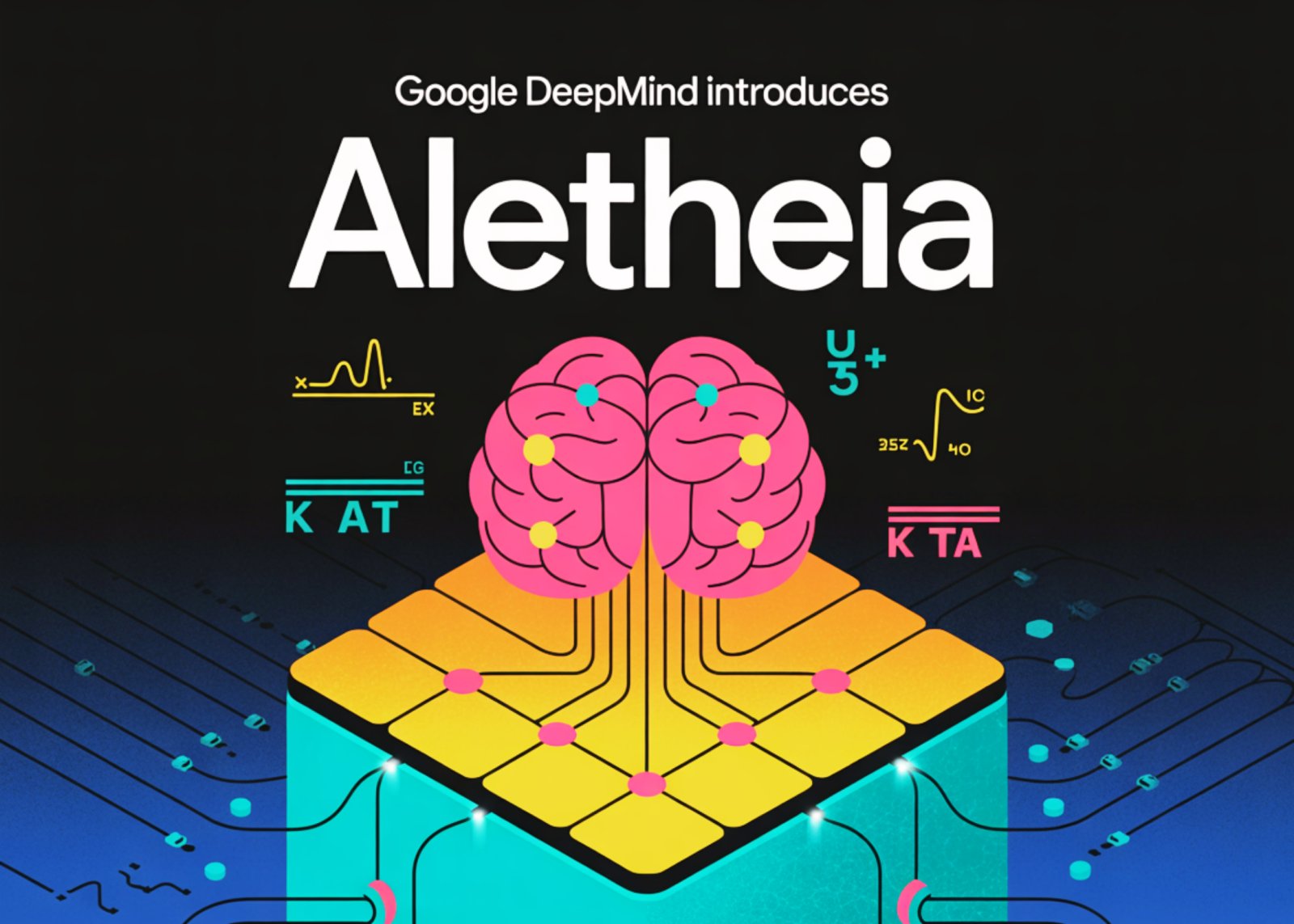

Google DeepMind team has introduced Aletheia, a specialized AI agent designed to bridge the gap between competition-level math and professional research. While models achieved gold-medal standards at the 2025 International Mathematical Olympiad (IMO), research requires navigating vast literature and constructing long-horizon proofs. Aletheia solves this by iteratively generating, verifying, and revising solutions in natural language.
The Architecture: Agentic Loop
Aletheia is powered by an advanced version of Gemini Deep Think. It utilizes a three-part ‘agentic harness’ to improve reliability:
- Generator: Proposes a candidate solution for a research problem.
- Verifier: An informal natural language mechanism that checks for flaws or hallucinations.
- Reviser: Corrects errors identified by the Verifier until a final output is approved.
This separation of duties is critical; researchers observed that explicitly separating verification helps the model recognize flaws it initially overlooks during generation.
Key Technical Findings
The development of Aletheia revealed several insights into how AI handles complex reasoning:
- Inference-Time Scaling: Allowing the model more compute at the time of a query—’thinking longer’—significantly boosts accuracy. The January 2026 version of Deep Think reduced the compute needed for IMO-level problems by 100x compared to the 2025 version.
- Performance: Aletheia achieved a 95.1% accuracy on the IMO-Proof Bench Advanced, a major leap over the previous record of 65.7%. It also demonstrated state-of-the-art performance on FutureMath Basic, an internal benchmark of PhD-level exercises.
- Tool Use: To prevent citation hallucinations, Aletheia uses Google Search and web browsing. This helps it synthesize real-world mathematical literature.
Research Milestones
Aletheia has already contributed to several peer-reviewed milestones:

- Fully Autonomous (Feng26): Aletheia generated a research paper calculating structure constants called eigenweights without any human intervention.
- Collaborative (LeeSeo26): The agent provided a high-level roadmap and “big picture” strategy for proving bounds on independent sets, which human authors then turned into a rigorous proof.
- The Erdős Conjectures: Deployed against 700 open problems, Aletheia found 63 technically correct solutions and resolved 4 open questions autonomously.
A Taxonomy for AI Autonomy
DeepMind proposed a standard for classifying AI math contributions, similar to the levels used for autonomous vehicles.
The paper Feng26 is classified as Level A2, meaning it is essentially autonomous and of publishable quality.
Key Takeaways
- Introduction of a Research-Grade AI Agent: Aletheia is a math research agent that moves beyond competition-level solving to autonomously generate, verify, and revise mathematical proofs in natural language. It is powered by an advanced version of Gemini Deep Think and an agentic loop consisting of a Generator, Verifier, and Reviser.
- Significant Gains via Inference-Time Scaling: DeepMind Researchers found that allowing the model more ‘thinking time’ at inference yields substantial gains in accuracy. The January 2026 version of Deep Think reduced the compute required for Olympiad-level performance by 100x and achieved a record 95.1% accuracy on the IMO-Proof Bench Advanced.
- Milestones in Autonomous Research: The system achieved several ‘firsts,’ including a research paper (Feng26) generated entirely without human intervention regarding arithmetic geometry. It also successfully resolved 4 open questions from the Erdős Conjectures database autonomously.
- Critical Role of Tool Use and Verification: To combat ‘hallucinations’—such as fabricating paper citations—Aletheia relies heavily on Google Search and web browsing. Additionally, decoupling the verification step from the generation step proved essential for identifying flaws the model initially overlooked.
- Proposal for a New Autonomy Taxonomy: The paper suggests a standardized framework for documenting AI-assisted results, featuring axes for autonomy (Level H to Level A) and mathematical significance (Level 0 to Level 4). This is intended to provide transparency and close the “evaluation gap” between AI claims and professional mathematical standards.
Check out the Paper.