
Running an independent blockchain has always come with a particular promise: control.
A standalone Layer 1 architecture allows projects to be the masters of their own destiny, set the rules of consensus, maintain their own validators and build infrastructure around their users, without relying on any other network.
But with great power comes great responsibility — and considerable expense.
Blockchains need enough users, developers and economic activity to support the infrastructure that secures them. For some smaller networks, keeping an entire ecosystem afloat no longer makes economic sense.
Zilliqa is the latest project to confront that reality, announcing plans last week to move away from its L1 architecture and become an Ethereum-based Layer 2 (L2) instead:

“We know it’s not great. For nine years we built and ran our own Layer 1. It hasn’t worked.”
“Usage never reached what a standalone chain needs,” the post explained. “Funding and liquidity for standalone L1s dried up. The recent hacks showed how much it takes to secure a chain alone. The data is onchain for everyone to see.”
Zilliqa is not alone.
Blockchain ecosystem Gnosis (which has always been Ethereum-adjacent) is also working to transition Gnosis Chain into an Ethereum-based network through its Ethereum Economic Zone (EEZ) initiative. Its RollupX test network intends to show how participating chains can share Ethereum settlement and synchronous composability as native rollups.
Gaming-focused Ronin blockchain also completed its move back to Ethereum as an L2 in May.
With interest in alt L1s drying up along with the funding, will we start to see more and more chains consolidating in the Ethereum ecosystem?
The cost of going it alone
Independent L1s generally have to keep several core functions going, including execution, consensus, data availability and settlement. They must also fund the token incentives used to secure their networks through staking.
“It comes down to a chain’s profitability,” Max Shannon, senior research analyst at Bitwise, tells Magazine.
ZIL becomes a Layer 2 on Ethereum. Source: Zilliqa
“L2s only need to maintain execution and do not necessarily need a token, which makes them a more attractive financial and operational proposition,” he says.
Shannon says the top ten largest projects are more financially sustainable. Coinbase and Robinhood’s L2 networks generated $48 million and $52 million in fees respectively over the last 365 days, with margins above 90%. The next eight largest chains each generated more than $1 million annually.
From 11th place onward, however, annual fees collectively amounted to less than $1 million. So a network may have ambitious technology and a dedicated community, but those things don’t necessarily pay the bills.
Ethereum is often criticized for giving away too much of its revenue to L2s, but that’s precisely what makes it attractive to set up projects there.
But just becoming an Ethereum L2 doesn’t automatically make a network profitable however. Shannon points to Optimism, Katana and Linea as examples of networks whose expenses outweigh their fee revenue. Projects like Blast have already been forced to shut down.
Ethereum as a liquidity ‘black hole’
Gnosis has targeted spring 2027 to complete its transition, which will see it give up its independent validator-based consensus in favor of Ethereum settlement.
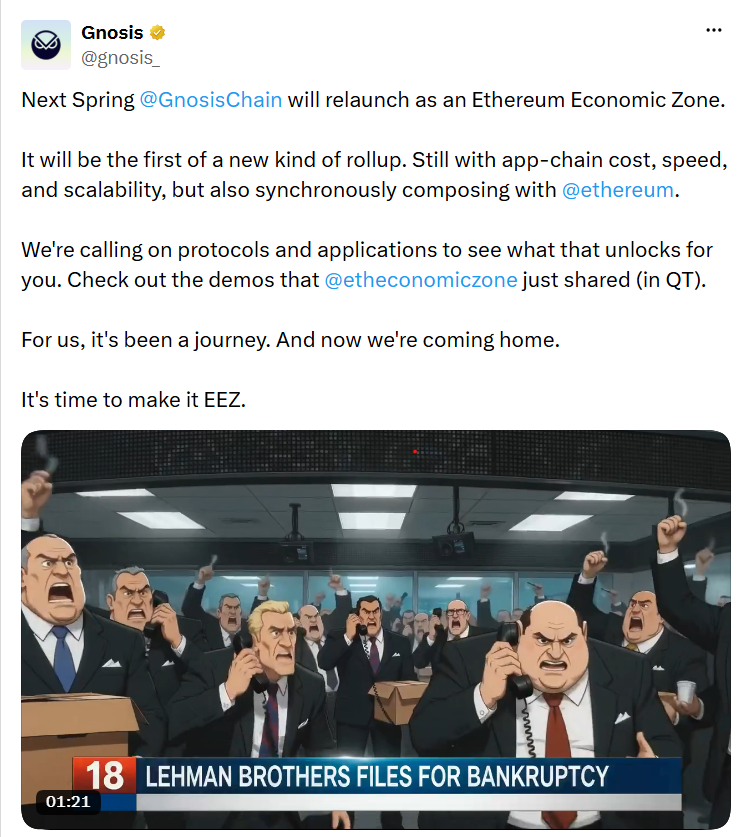
Gnosis Chain will relaunch as an Ethereum Economic Zone. Source: Gnosis
“Two years ago I gave a talk about ‘native Rollups’ that would truly extend Ethereum instead of being isolated chains,” co-founder Martin Köppelmann said, adding that RollupX “even goes beyond what I had imagined back then!”
Gnosis’s EEZ initiative aims to enable separate Ethereum-based networks interact synchronously, so a smart contract on one network can call another and use its response within the same transaction, without relying on the usual bridge-and-wait process.
That’s a prospect that has some Ethereum supporters particularly bullish, with ETH bull materkel describing the EEZ as a potential “black hole for liquidity,” and saying it could allow participating networks to tap into Ethereum’s total value locked (TVL) and strengthen its position as a liquidity hub.
Could network effects, and increased interoperability draw more and more chains into Ethereum’s orbit?
Beyond the cost savings
It isn’t only the operating cost economics that make sense. Projects can also tap into an established ecosystem of applications and developers rather than building those network effects from scratch.
Alex Gluchowski, co-founder and chief executive of Matter Labs, the company behind Ethereum L2 ZKsync, says he expects more L1 teams to maintain their own chains while using Ethereum for settlement.
“Running an independent L1 means maintaining its security as well as building something people want to use,” Gluchowski tells Magazine.
“Sharing Ethereum’s security gives a team more room to focus on its users. I see very few user needs that require an independent L1 rather than an Ethereum-based chain.”
But Gluchowski says sovereignty and Ethereum integration are not mutually exclusive, since chains can retain control over their rules and operations while using Ethereum for shared settlement.
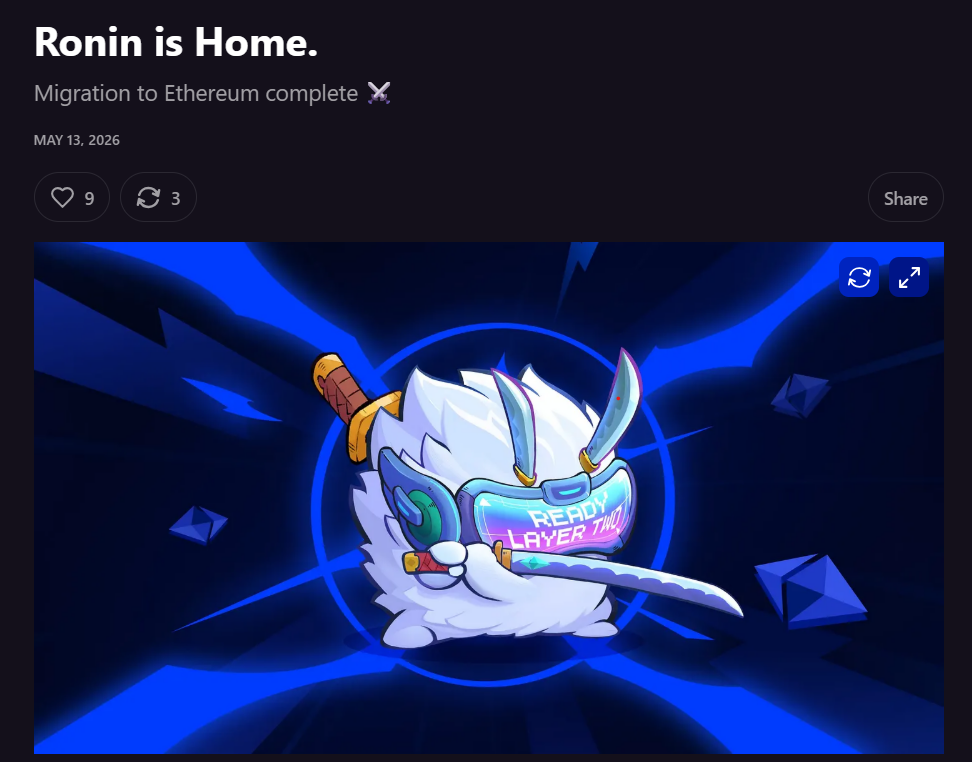
Ronin completed migration to Ethereum in May. Source: Ronin
And for applications handling sensitive financial information, maintaining a private environment under their own control can be essential, he says. Shared settlement does not have to mean exposing confidential transaction data.
The biggest obstacle today is that all the L2s are effectively isolated from each other and from Ethereum. It’s certainly possible to jump between them, but its far from seamless and interoperability is poor.
“Fragmentation is already happening,” Gluchowski says, pointing to the difficulty of connecting networks when transactions involve privacy.
Interoperability between private environments will become more important as more applications seek to combine confidential activity with access to public blockchain liquidity, he says.
Does every chain need Ethereum?
Shannon cautions against describing the market as undergoing straightforward consolidation around Ethereum.
Some large institutions are launching L2 networks, he says, including Coinbase and Robinhood, but others are still choosing to build independent L1s, like Circle’s Arc, Stripe’s Tempo, or Hyperliquid’s purpose-specific perpetual futures blockchain.
“So there is no clear conclusion to the L1 versus L2 debate as yet,” he says.