
A technical discussion ignited on X after on-chain analyst Willy Woo released what he termed a “BEGINNER’S GUIDE TO BEING QUANTUM SAFE,” recommending Bitcoin holders to transfer coins from Taproot addresses (bc1p) to SegWit (bc1q) or older P2PKH/P2SH formats and to refrain from spending until post-quantum safeguards are implemented.
Steps to Ensure Bitcoin is “Quantum-Safe”
“Previously, it was essential to secure your PRIVATE KEY (your seed phrase). In the era of looming quantum computers (BSQC), it’s crucial to also protect your PUBLIC KEY. Essentially, a BSQC can deduce your private key from your public key. The current Taproot addresses (the latest format) are NOT secure; these start with ‘bc1p’ and incorporate the public key directly into the address, which is problematic,” Woo stated on Nov. 11.
His argument is based on a well-recognized difference in Bitcoin script types: Taproot (P2TR) directly encodes a public key in both the output and address, whereas legacy formats like P2PKH/P2SH and SegWit P2WPKH hash the public key and display it only when coins are spent. This architectural distinction is significant in a future where a sufficiently powerful quantum computer could derive a private key from a public key that has been exposed. Independent references also affirm that P2TR indeed contains a public key within its output, while P2PKH keeps it hidden until use.

Woo’s temporary strategy is straightforward: transfer UTXOs to bc1q (or “1”/“3”) addresses, continue receiving to that address, but “NEVER send BTC out of it” until Bitcoin releases a quantum-resistant upgrade—after which holders should transfer during low network congestion, minimizing the exposure timeframe for a public key in the mempool: “Send your BTC to the new quantum-safe address when the network is NOT congested; once you send, the private key is revealed briefly. It’s unlikely that a BSQC will steal your coins in that short timeframe.”
He also cautioned that P2PK “Satoshi-era” outputs are at the highest risk, suggesting that lost coins with previous spending history could be susceptible. “Satoshi’s 1M coins utilizing an outdated P2PK address could be stolen (unless future soft forks prevent this),” he stated, adding that ETFs, treasuries, and exchange cold storage “can be quantum resistant if custodians act” well before any soft fork.
Woo described the industry’s expectations as “2030 and beyond” for the onset of “Q-Day,” while emphasizing that standards for quantum resistance are already being developed across the broader cryptographic landscape.
Former Bitcoin Core maintainer Jonas Schnelli agreed with the caution but contested the terminology. He labeled Woo’s approach as a sensible precaution for unspent coins—“P2PKH provides years of protection while Taproot exposes your pubkey immediately”—but disagreed with calling it “quantum safe.”
In Schnelli’s perspective, once any spend is broadcasted, “your pubkey enters the mempool. A quantum attacker could decipher your key and execute a double-spend before your transaction is confirmed (~10 minutes).” He concluded by stating: “It’s a wise precaution, not a permanent fix.”
As of the time of writing, BTC was priced at $104,693.
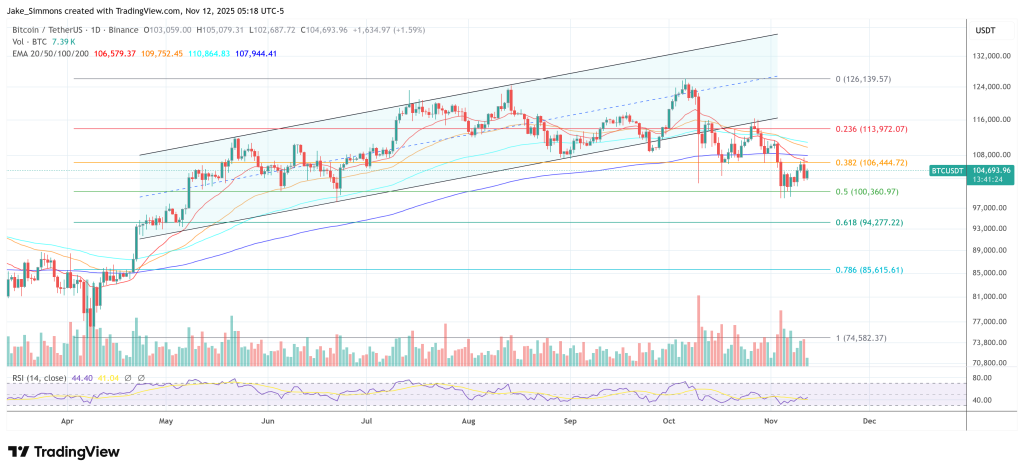
Featured image created with DALL.E, chart from TradingView.com

Editorial Process for bitcoinist is focused on providing meticulously researched, accurate, and unbiased information. Our stringent sourcing standards ensure that each page undergoes thorough review by our team of top technology experts and experienced editors. This process guarantees the integrity, relevance, and value of our content for our audience.