
Key Takeaways
- Typesafe opened Jev to everyone Sunday, tossing new users $5 in credits to see what its speedy AI can do.
- Jev gave bitcoin a 55% shot at $85,000, while Polymarket traders were far more confident at 81%.
- Jev experiments are popping up across crypto, from 300-millisecond trading bots to token-scoring tools.
Jev Opens to Everyone After Two Years in Stealth
Typesafe AI’s System One model, Jev, launched last week, though access was initially limited by a waitlist that kept the doors closed to some prospective users. On Sunday, the team announced that “Jev is now available to everyone. No waitlist,” and Typesafe sweetened the wider release by giving every new user $5 in credits. Jev is an AI model, and the creators have been working on the project for two years in stealth mode and have raised $40 million.
Unlike ChatGPT or Claude, Jev is given a state and closed questions, and it returns typed probabilities in about 70 to 500 milliseconds, at $0.042 per million input tokens, output free. It cannot chat. Typesafe AI’s Jev is built to talk directly to the information you give it and other computer programs. When you supply it with some information and ask it a question, it just picks the best answer from a multiple-choice list you provided and tells you how confident it is in that choice.
Because it never tries to write its own words, it is incredibly fast and completely avoids making up fake information, which helps other software run reliably without getting confused. People have been using it for all types of things, like video games with real-time game logic, predictions, parallel information extraction, live scoring and validation, and much more.
Bitcoin Price Bets Put Jev’s Split-Second Judgment to the Test
On Sunday evening, Bitcoin.com News tested Jev and handed it Polymarket’s live event “What price will bitcoin hit in 2026?” data. Jev was asked the only kind of question it can answer: yes or no. Would a Binance one-minute candle print $85,000 before 2027? $90,000? $100,000? The crowd already had a price. Volume on the event sat near $67.8 million. $80,000 had been printed. $75,000 and $65,000 had been tagged.

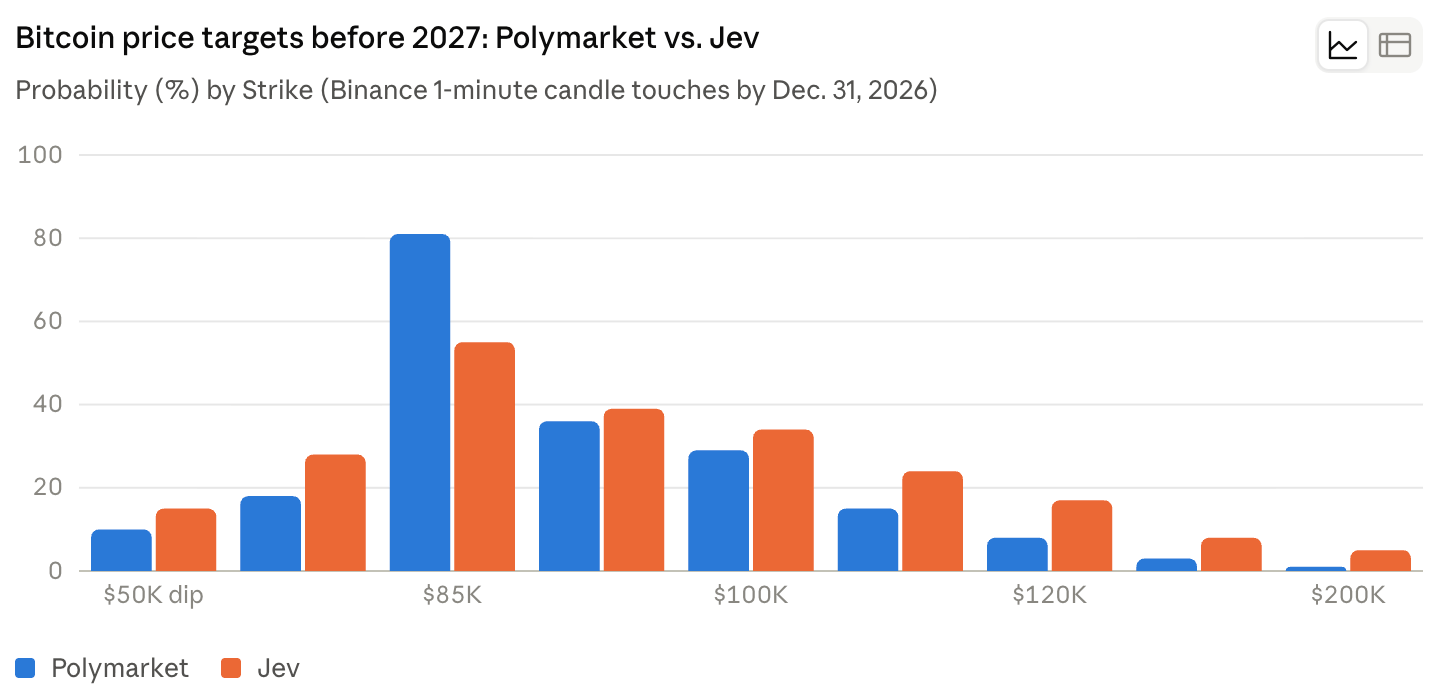
On the prediction marketplace, Polymarket, bettors were paying 81 cents on the dollar that $85,000 hits next. Typesafe’s Jev, which does not write sentences, put that strike at 55%. Then 48% for $90,000 and 34% for $100,000. A dip to $70,000 came back 50%, a shrug. A test like this barely scratches the surface compared with what other individuals across the crypto space are building and experimenting with. Some are constructing stablecoin strategies, meme coin launch scores, and token-focused systems as well.
Crypto Builders Turn Jev Into a 300-Millisecond Trading Engine
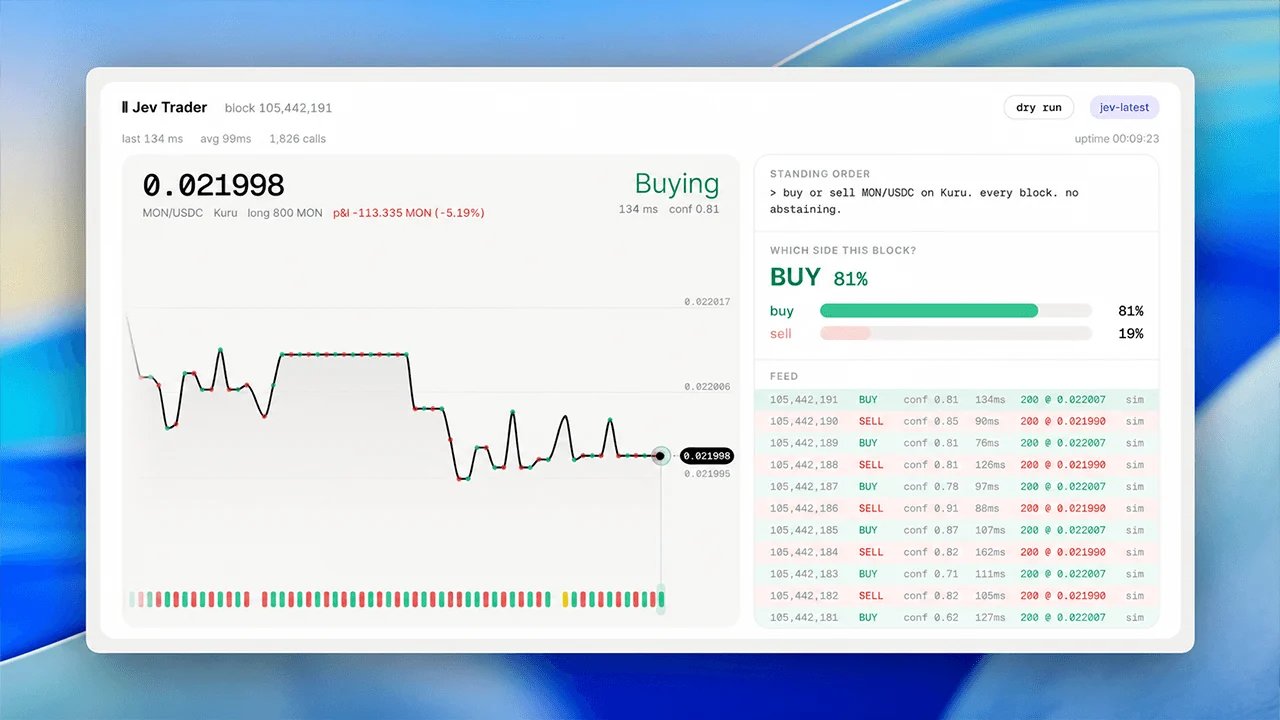
Jev’s speed is why builders are wiring it into loops almost as fast as they can type. On Sept. 16, Jarrod Watts, lead AI engineer at Monad, pointed Jev at a price feed, asked buy or sell, and let a bot rest a post-only limit on Kuru’s onchain book about every 300 milliseconds. “Jev decides if it should ‘buy’ or ‘sell,’ given the price feed of an asset pair, and executes real trades,” Watts wrote on X. The Monad dev also open-sourced the bot under jarrodwatts/jev-trader.
Many repositories are quickly becoming templates for Jev-style, crypto-infused experiments. Projects, forks, and ports are cropping up across the crypto ecosystem, accompanied by a steady stream of social media posts showcasing these concepts operating in the wild. Right now, Jev signals a quiet shift: AI’s value may lie less in conversation than in fast, bounded judgment.
By refusing to generate prose, it can sidestep hallucination and become infrastructure, not a personality. The real question isn’t whether it’s right, but whether markets should increasingly defer to a confidence score. For now, it is simply a curious new experiment to tinker with on the ever-expanding AI horizon.